Crocodile: A Stylish 3D Display Typeface for Impactful Designs
In the realm of graphic design, typography serves as a primary vehicle for communication, setting the tone before a single word is read. Among the vast array of available typefaces, Crocodile has emerged as a distinctive option for designers seeking a bold, three-dimensional aesthetic. This font is characterized by its stylized 3D structure, offering a unique visual weight that commands attention. For professionals and hobbyists alike, understanding the specific attributes of Crocodile is essential when selecting tools for posters, flyers, and prints where visual impact is paramount.
Defining the Aesthetic of Crocodile
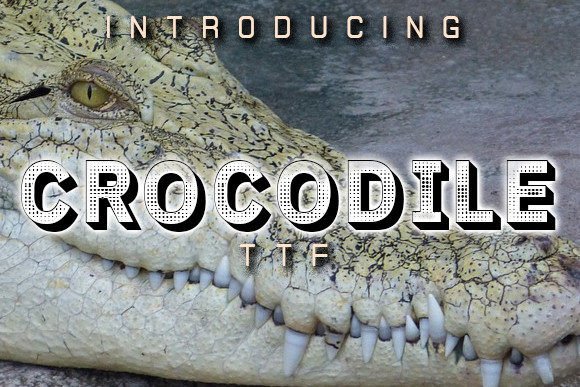
Crocodile is best described as a creative display font. Unlike serif or sans-serif typefaces designed for long-form reading, display fonts are engineered for headlines, titles, and short bursts of text. The defining feature of Crocodile is its dimensional quality. It mimics the appearance of extruded lettering, creating an illusion of depth and volume on a two-dimensional surface. This 3D effect is not merely an add-on but is intrinsic to the glyph design, giving the text a solid, architectural presence.
The style often evokes a sense of retro-modernism, blending the chunky proportions of mid-century advertising with contemporary digital precision. The letters are typically wide and robust, with sharp angles or rounded edges depending on the specific variation, all rendered to look as though they are popping off the page. This makes Crocodile particularly effective in contexts where the typography itself acts as an image or a central graphic element rather than just a carrier of information.
Strategic Applications and Ideal Use Cases
When evaluating whether Crocodile aligns with a specific project, one must consider the medium and the message. The font excels in situations requiring high visibility and immediate engagement. Its structural density makes it a strong fit for:
- Event Posters: Concerts, festivals, and club nights often require typography that cuts through visual noise. The 3D nature of Crocodile ensures legibility from a distance.
- Promotional Flyers: For limited-run sales or product launches, the font adds a premium, tactile feel to digital or printed flyers.
- Apparel and Merchandise: The bold lines translate well to screen printing and embroidery, making it suitable for t-shirt graphics and streetwear branding.
- Social Media Graphics: In feeds dominated by scrolling, the dimensional aspect of the font can stop the eye more effectively than flat text.
The decision to use Crocodile should be driven by the need for a "hero" element. If the design goal is to create a focal point that anchors the composition, this typeface provides the necessary gravity. It works exceptionally well when paired with minimalistic backgrounds or contrasting flat colors, allowing the 3D effect to stand out without competition.
Benefits and Design Advantages
One of the primary benefits of incorporating Crocodile into a design workflow is its ability to reduce the need for additional effects. Because the 3D styling is built into the font file, designers do not need to spend time manually extruding text in vector software or applying complex layer styles in raster programs. This efficiency can significantly speed up the prototyping phase of a project.
Furthermore, the font offers a high degree of versatility within its niche. While it is inherently bold, it can be adapted through color gradients, textures, and lighting effects to suit various moods—from playful and vibrant to industrial and gritty. The geometric foundation of the letters ensures that even when scaled to massive sizes for large-format prints, the edges remain crisp and the proportions stay balanced.
Tradeoffs and Limitations
Despite its strengths, Crocodile is not a universal solution. A critical evaluation reveals several tradeoffs that designers must acknowledge. The most significant limitation is readability at smaller sizes. The intricate details that create the 3D illusion can become muddy or indistinct when the font is reduced for body copy, captions, or mobile interfaces. Consequently, Crocodile should strictly be reserved for headings and display purposes.
Additionally, the strong personality of the font can sometimes overpower other design elements. If a layout requires a delicate balance between imagery and text, the heavy visual weight of Crocodile might disrupt the harmony. It demands space; cramped layouts will diminish its impact and make the text feel claustrophobic. Designers must also consider licensing and compatibility, ensuring the font format supports the intended output methods, whether for web embedding or high-resolution print production.
Comparative Considerations: When to Choose Alternatives
There are scenarios where alternatives to Crocodile may be more appropriate. If the project involves extensive body text, a clean sans-serif or a readable serif typeface is a superior choice to maintain reader comfort over long passages. Similarly, if the brand identity calls for subtlety, elegance, or minimalism, a flat, thin, or handwritten font might convey the intended message more accurately than the assertive 3D style of Crocodile.
Designers working on user interface (UI) projects should also exercise caution. While Crocodile can work for app icons or splash screens, it is generally unsuitable for navigation menus or data tables where clarity and speed of recognition are critical. In these cases, variable fonts with multiple weights or highly legible system fonts offer better functionality.
Practical Decision-Making Insights
Selecting the right typeface is a strategic decision that impacts the overall success of a design. To determine if Crocodile is the right fit, ask the following questions:
- What is the viewing distance? If the audience will view the design from afar, the boldness of Crocodile is an asset.
- Is the text quantity low? Ensure the content is limited to headlines or short phrases to maintain legibility.
- Does the brand voice match the style? Evaluate if the energetic and solid character of the font aligns with the brand's personality.
- Are there technical constraints? Verify that the final output medium can reproduce the fine details of the 3D effect without loss of quality.
Ultimately, Crocodile is a powerful tool in a designer's arsenal, specifically tailored for projects that demand presence and style. By understanding its capabilities and respecting its limitations, creatives can leverage this stylish 3D typeface to produce posters, flyers, and prints that resonate with audiences. It is not merely a font but a design statement, best utilized when the goal is to make a lasting, dimensional impression.